
Laparoscopy Training Services in Kenya are playing an increasingly important role in advancing modern surgical practice. As healthcare continues to move toward minimally invasive techniques, surgeons and medical professionals need practical, evidence-based training that helps them develop the technical skills, clinical judgment, and confidence required in the operating room.
Dr. Lance Mayabi offers professional laparoscopy training services in Kenya, focusing on practical surgical education, minimally invasive techniques, patient safety, and the application of modern laparoscopic skills in real-world clinical settings.
As a General and Laparoscopic Surgeon, Dr. Mayabi has extensive experience in minimally invasive surgery, surgical gastroenterology, and advanced laparoscopic procedures. He is also actively involved in surgical education and mentorship, including his role as Program Director for the COSECSA General Surgery Program at The Karen Hospital.
What Is Laparoscopy Training?
Laparoscopy training is specialized surgical education designed to help healthcare professionals develop the knowledge and technical skills required to perform minimally invasive procedures.
Unlike traditional open surgery, laparoscopic procedures are performed through small incisions using a laparoscope, camera systems, and specialized surgical instruments.
Effective laparoscopic training goes beyond understanding the theory. Surgeons need to develop:
- Hand-eye coordination
- Instrument handling
- Camera navigation
- Depth perception
- Tissue handling
- Intracorporeal suturing
- Knot-tying techniques
- Surgical decision-making
- Safe patient positioning
- Operating-room teamwork
- Management of intraoperative challenges
For this reason, high-quality laparoscopy training in Kenya should combine structured teaching with practical skills development and experienced mentorship.
Laparoscopy Training Services in Kenya by Dr. Lance Mayabi
Dr. Lance Mayabi provides professional surgical training designed to help medical professionals strengthen their laparoscopic skills and understand the principles behind safe minimally invasive surgery.
His training approach emphasizes practical learning, patient safety, technical precision, and the application of laparoscopic techniques in modern surgical practice. His official training service describes programs focused on practical, high-impact surgical skills, modern healthcare standards, hands-on learning, and real-world operating-room application.
The goal is not simply to teach participants how laparoscopic equipment works. It is to develop surgeons who can apply minimally invasive surgical principles safely, systematically, and confidently.
Why Laparoscopic Surgery Training Matters in Kenya
The demand for minimally invasive surgery continues to grow as patients and healthcare providers increasingly recognize the potential advantages of laparoscopic approaches.
Laparoscopic surgery can, where clinically appropriate, offer advantages such as smaller surgical incisions, reduced postoperative discomfort, shorter hospital stays, and faster recovery compared with some traditional open procedures.
However, these potential benefits depend heavily on appropriate patient selection, surgical expertise, equipment, and adherence to safe surgical principles.
This makes laparoscopic surgery training in Kenya an important part of strengthening surgical capacity and improving access to modern surgical care.
Who Can Benefit From Laparoscopy Training?
Laparoscopy training may be valuable for medical professionals seeking to develop or strengthen their minimally invasive surgical capabilities.
Depending on the specific program, participants may include:
General Surgeons
General surgeons can strengthen their knowledge and technical skills in commonly performed laparoscopic procedures and advanced minimally invasive techniques.
Surgical Residents
Residents can gain structured exposure to laparoscopic principles and develop foundational skills that complement their formal surgical training.
Medical Specialists
Specialists whose practice involves minimally invasive procedures may benefit from focused workshops and advanced surgical skills training.
Surgical Teams
Modern laparoscopic surgery requires effective coordination between surgeons, assistant surgeons, nurses, anesthetists, and theatre staff. Training can therefore contribute to stronger operating-room teamwork.
What Does Laparoscopy Training Cover?
The exact curriculum can vary depending on the level and objectives of each training program. However, professional laparoscopic training may cover areas such as:
1. Fundamentals of Laparoscopic Surgery
Participants are introduced to the principles of minimally invasive surgery, laparoscopic equipment, surgical ergonomics, and operating-room setup.
2. Laparoscopic Instruments
Understanding laparoscopic instruments is essential for safe and efficient surgery. Training may cover instrument selection, handling, maintenance, and appropriate use.
3. Camera Navigation
A stable and correctly positioned camera is fundamental to laparoscopic surgery. Participants can develop techniques for maintaining optimal visualization and assisting the operating surgeon effectively.
4. Hand-Eye Coordination
Laparoscopic surgery requires surgeons to operate instruments while viewing their movements on a monitor rather than directly observing the operative field.
Structured practice helps improve this essential psychomotor skill.
5. Laparoscopic Suturing and Knot Tying
Intracorporeal suturing and knot tying are important technical competencies in advanced laparoscopic surgery.
Training can help participants develop precision, instrument control, and efficiency.
6. Surgical Decision-Making
Technical ability is only one component of safe surgery. Effective laparoscopic training should also reinforce clinical judgment, patient selection, surgical planning, and recognition of situations where conversion to open surgery may be necessary.
7. Patient Safety
Patient safety remains central to minimally invasive surgery.
Training can emphasize appropriate surgical preparation, safe operating-room practices, complication awareness, and structured approaches to difficult surgical situations.
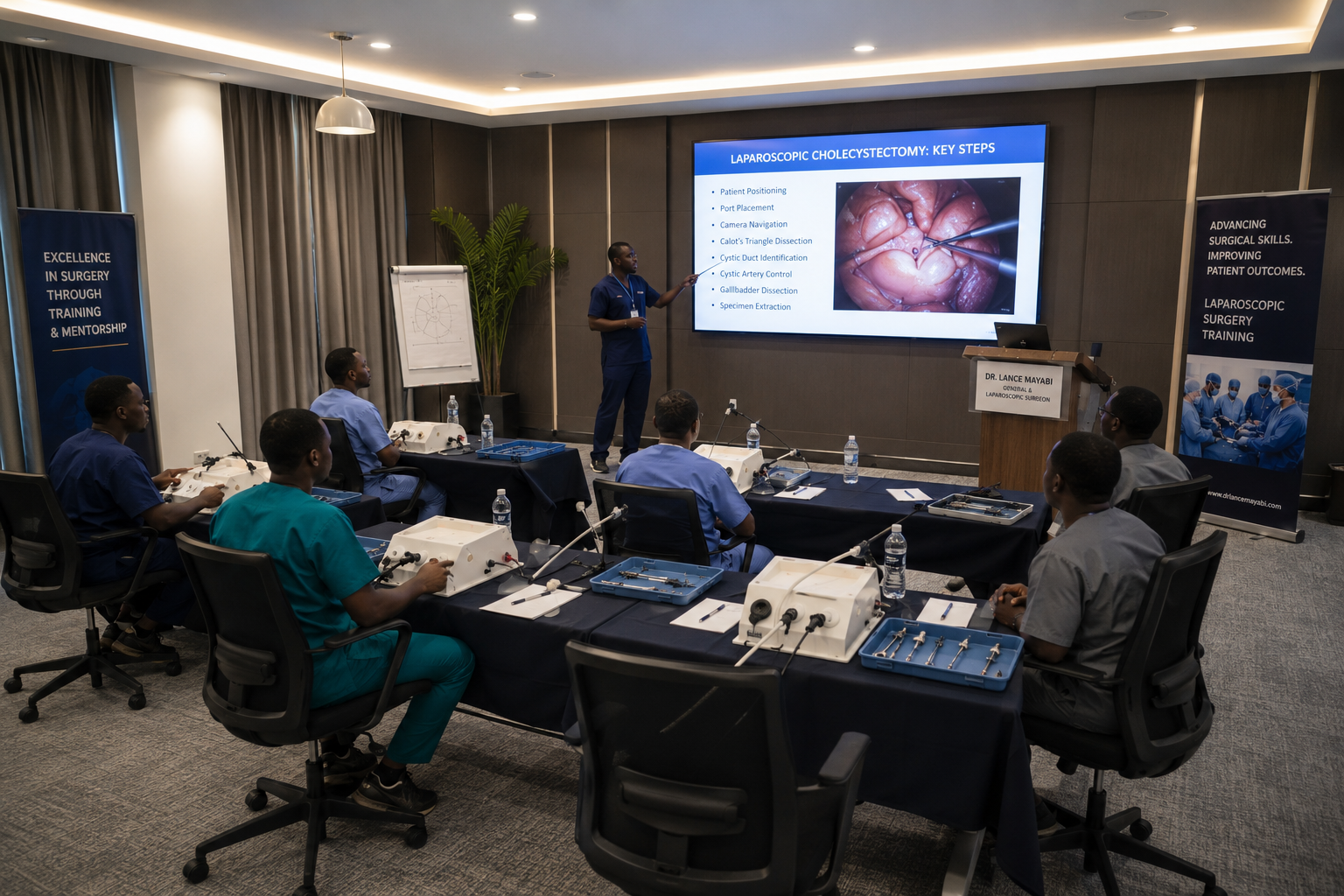
Practical Laparoscopy Training in Nairobi, Kenya
For medical professionals looking for laparoscopy training in Nairobi, access to experienced surgical educators and appropriate training environments can make a significant difference.
Dr. Lance Mayabi is based in Nairobi and has been involved in surgical education, mentorship, and the development of advanced laparoscopic and endoscopic services. The Karen Hospital identifies him as Head of Surgery and notes his involvement in expanding advanced laparoscopic and endoscopic services.
His professional background also includes participation in laparoscopic and surgical skills courses, workshops, and advanced surgical education. His professional profile lists training in areas including basic laparoscopy, laparoscopic hernia surgery, intermediate laparoscopy, laparoscopic colorectal surgery, and advanced hernia techniques.
Learn From an Experienced Laparoscopic Surgeon
Choosing the right trainer is an important part of surgical education.
Dr. Lance Mayabi is a Fellow of the College of Surgeons of East, Central and Southern Africa (FCS-ECSA) and a Fellow of the American College of Surgeons (FACS). He is also a member of the Society of American Gastrointestinal and Endoscopic Surgeons (SAGES).
His experience combines clinical practice with surgical leadership and mentorship, creating an educational environment focused on translating surgical knowledge into practical skills.
He has also been involved in collaborative laparoscopy skills training initiatives, sharing knowledge and surgical techniques with the next generation of surgeons and other healthcare professionals.
Laparoscopy Workshops and Surgical Skills Development
Workshops provide an effective way for medical professionals to focus on specific laparoscopic skills within a structured learning environment.
Depending on the training objectives, a workshop may focus on:
- Basic laparoscopic skills
- Advanced laparoscopic techniques
- Laparoscopic suturing
- Intracorporeal knot tying
- Laparoscopic hernia surgery
- Gastrointestinal procedures
- Surgical decision-making
- Complication management
- Operating-room efficiency
- Patient safety
Focused workshops can be particularly useful for professionals who want to improve a specific technical competency or gain additional exposure to minimally invasive surgical techniques.
Why Choose Dr. Lance Mayabi for Laparoscopy Training?
Experienced Surgical Educator
Dr. Mayabi combines clinical experience with a strong commitment to surgical education and mentorship.
Focus on Minimally Invasive Surgery
Laparoscopy is a major component of his surgical practice and professional expertise.
Practical Learning
His training services are designed around practical, high-impact surgical skills and real-world application rather than theory alone.
Commitment to Patient Safety
Safe surgery requires more than technical proficiency. Training must also reinforce appropriate clinical decision-making, teamwork, and patient-centered care.
International Surgical Standards
Dr. Mayabi’s professional affiliations include FCS-ECSA, FACS, and SAGES, reflecting engagement with recognized surgical professional organizations and contemporary minimally invasive surgical practice.
The Future of Laparoscopic Surgery in Kenya
As minimally invasive surgery continues to develop, surgical training will remain essential to expanding access to advanced procedures across Kenya and the wider East African region.
Building local surgical expertise can help hospitals develop stronger minimally invasive surgery programs while giving surgeons opportunities to continually improve their technical capabilities.
Training initiatives led by experienced surgeons can also contribute to a culture of continuous professional development, mentorship, collaboration, and patient safety.
Advance Your Surgical Skills With Laparoscopy Training in Kenya
Modern surgery demands continuous learning, technical precision, and a commitment to patient safety.
If you are a medical professional looking to strengthen your laparoscopic surgery skills in Kenya, professional training under an experienced laparoscopic surgeon can provide valuable knowledge, practical exposure, and mentorship.
Dr. Lance Mayabi’s Laparoscopy Training Services are designed to help medical professionals develop practical surgical skills, understand modern minimally invasive techniques, and apply their knowledge effectively in clinical practice.
Whether you are looking for laparoscopy training in Nairobi, laparoscopic surgery courses in Kenya, surgical skills training, or advanced minimally invasive surgery education, professional training can be an important step toward improving surgical competence and contributing to better patient care.
Take the next step in your surgical education. Contact Dr. Lance Mayabi to learn more about available laparoscopic training services and upcoming surgical education programs.
Dr. Lance Mayabi
General & Laparoscopic Surgeon
Nairobi, Kenya
Phone: +254 780 310 990
Email: drlancemayabi@gmail.com